
WISMO tickets eat 20-50% of your support queue. Learn the 3-layer defense strategy Shopify stores use to cut order-status tickets by 80% with AI.
How to Reduce WISMO Tickets by 80% with AI in 2026 (Shopify Guide)
Your support inbox isn't broken. It's just full of the same question.
"Where's my order?" "Has my package shipped?" "It says in transit but it's been four days, is it lost?"
If you want to reduce WISMO tickets on your Shopify store, you're not alone. WISMO (Where Is My Order) is the most common question in e-commerce support. If you're doing more than a few hundred orders a month, you already know the acronym. You've probably groaned at it. And you're spending somewhere between 20% and 50% of your entire support budget answering a question that, nine times out of ten, has a perfectly boring answer: the package is on its way.
Gorgias published their own data on this — 18% of all incoming requests across their platform are WISMO. Shiprocket puts it higher, at 30–50%. ShippyPro claims 50–80% during peak seasons. The real number for your store depends on your shipping speed, your carrier choices, and how much proactive communication you're already doing. But the floor is around one in five tickets. The ceiling? Most of your queue.
Here's what makes WISMO maddening: these aren't hard tickets. Nobody's asking you to troubleshoot a broken product or negotiate a complex return. They want a tracking number. Or a delivery estimate. Or just someone to say "your package shipped yesterday — here's the link." Your best support agents are spending hours every day copy-pasting tracking URLs. That's expensive, demoralizing, and completely solvable.
We've spent months studying how Shopify stores attack this problem. The stores that actually cut WISMO by 80%+ don't do one thing. (If you're still evaluating helpdesks, our Tidio vs Squire and Gorgias vs Squire comparisons break down who handles WISMO best.) They build a three-layer defense. And the third layer — AI — is what separates the stores still drowning from the ones that barely notice WISMO anymore.
Tired of answering "where's my order?" 500 times a month? See how AI handles it →
The Real Cost of WISMO (It's Worse Than You Think)
Let's do the math. Skip this section if you already hate WISMO. Stay if you want ammunition for your boss.
Say you're doing 5,000 orders a month. A conservative 15% WISMO rate gives you 750 order-status tickets every month. At an average handling time of 2 minutes per ticket (and that's generous, since some require carrier lookups, back-and-forth, follow-ups), you're burning 25 agent-hours a month on one question type. Twenty-five hours.
At $4 per ticket (the industry average for a mid-market e-commerce support operation), that's $3,000 a month. $36,000 a year. For a question where the answer is almost always "it's on the way."
But the cost isn't just dollars. It's opportunity cost. Every WISMO ticket your team handles is a ticket that isn't a product question (potential conversion), a return that needs human judgment, or a VIP customer who needs white-glove attention. WISMO crowds out the work that actually moves the needle.
And during BFCM? Your order volume doubles or triples. Your WISMO rate spikes to 50–70% because carriers are slower, customers are anxious about gifts, and your team is already stretched thin. That's when the model breaks.
Why the Usual Fixes Fall Short
You've probably already tried some version of these. They help. They're not enough.
FAQ pages. Nobody reads them. Seriously. You can have the most beautiful "Shipping & Tracking" page on the internet and customers will still email support. It's not because they're lazy. It's because their question feels specific ("where is MY order?") even though the answer is generic.
Email confirmations. Great in theory. In practice, your shipping confirmation lands between a Costco promo and a Duolingo guilt trip. It gets buried. Three days later, the customer has no idea where to find it, so they message you.
Tracking pages. Better. Apps like Parcel Panel, AfterShip, and Malomo give you branded tracking pages embedded on your site. Malomo claims a 50% reduction in WISMO from this alone. We believe it, for the customers who actually visit the page. But plenty of shoppers never click through. They go straight to "Contact Us."
"Just hire more agents." Sure, and just burn more money. WISMO grows linearly with orders. Every 1,000 new orders creates 150–200 new WISMO tickets. Staffing up for that is like bailing water without plugging the hole.
Each of these approaches catches some WISMO. None of them catch all of it. That's why you need layers. (For a broader look at where WISMO fits into overall support operations, see our customer support cost breakdown.)
The 3-Layer WISMO Defense
Think of it as a funnel. Each layer catches what the previous one missed.
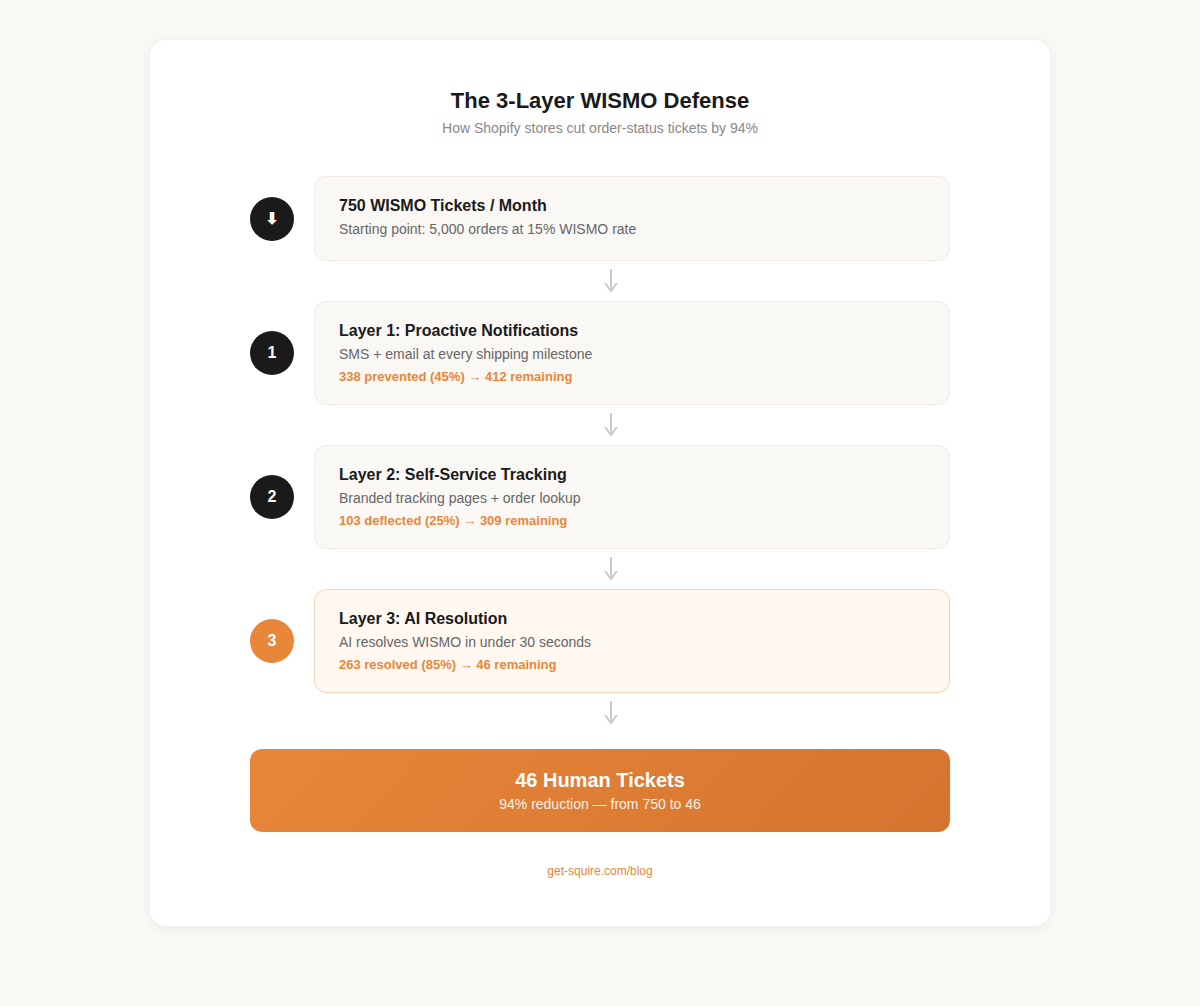
Layer 1: Proactive Notifications — stop the question before it's asked. Layer 2: Self-Service Tracking — let customers find the answer themselves. Layer 3: AI Resolution — when they still contact you, resolve it in seconds.
The stores hitting 80%+ reduction are running all three. Let's break each one down.
Layer 1: Proactive Notifications (Prevents 40–50% of WISMO)
The single best thing you can do is answer the question before the customer thinks to ask it. Every shipping milestone should trigger a notification.
What to send:
- Order confirmed (immediately)
- Order shipped + tracking number + carrier name (within hours of fulfillment)
- In transit update (when carrier scans the package)
- Out for delivery (morning of delivery day)
- Delivered (with delivery confirmation)
Shopify handles the basics out of the box: order confirmation and shipping confirmation emails go out automatically. But "the basics" aren't enough.
Where most stores stop too early: They send the shipping confirmation and then go silent for 3–7 days. That silence is where WISMO lives. The customer placed an order Monday, got a "shipped!" email Tuesday, and by Thursday they're wondering if their package fell off a truck. One mid-transit update kills that anxiety.
Channels matter. Email open rates hover around 20%. SMS open rates? 98%. If you're only notifying via email, four out of five customers never see your update. Klaviyo, Postscript, and Shopify's own SMS features let you add text notifications for key milestones. We've talked to stores that dropped WISMO by 35% just by adding SMS shipping updates. No new tools, no AI, just a text message.
Pro tip from a merchant we work with: They added estimated delivery dates to their shipping confirmation email. Not just "your order has shipped" but "your order shipped via USPS Priority and should arrive by Friday, February 21." That one line cut their WISMO by an additional 15%. Customers don't want tracking numbers. They want dates.
Layer 2: Self-Service Tracking (Catches Another 20–30%)
Some customers will still want to check on their order. That's fine. Make it effortless.
Branded tracking pages are the biggest win here. Instead of sending customers to USPS.com or FedEx's labyrinthine tracking page, embed a tracking page on your own site. Parcel Panel (free for under 200 orders/month), AfterShip, and Malomo all do this. The customer clicks one link, lands on your site, sees their order status with your branding and their estimated delivery date.
Optimize your Shopify order status page. This is the page customers land on after checkout, and most stores leave it completely default. Customize it. Add estimated delivery. Add a "track your order" button that's impossible to miss. Add your support chat widget (more on this in Layer 3).
Order lookup in chat. Some stores add a simple "Track My Order" button to their chat widget. Customer clicks it, types their order number or email, and gets instant status. No human involved. This isn't AI (yet). It's a basic lookup flow. But it intercepts a surprising number of WISMO contacts.
The principle is simple: every extra click between "I wonder where my order is" and "oh, it'll be here Thursday" creates a support ticket. Reduce clicks, reduce tickets.
Layer 3: AI-Powered Resolution (Eliminates the Rest)
Here's where the game changes.
Layers 1 and 2 are preventive. They stop WISMO before it reaches your inbox. But they don't catch everything. Customers who missed notifications, who couldn't find the tracking page, who have a genuinely delayed package, or who just prefer talking to someone. They'll still contact you. And that remaining 30–40% of WISMO tickets is still a lot of volume.
This is where AI customer support tools earn their keep.
How it works: Customer sends "where's my order?" through email, chat, Instagram, wherever. The AI identifies the intent, pulls their order from Shopify using their email or order number, checks real-time tracking data from the carrier, and responds with the current status, all in under 30 seconds. No templates. No macros. An actual conversational response.
What makes AI different from canned responses: A macro says "Here's your tracking link: [link]." AI says "Hey Sarah, I checked on order #4821. It shipped via USPS Priority on Monday and is currently in transit through the Chicago sorting facility. Based on the tracking, it should arrive by Thursday. Here's the live tracking link if you want to follow along: [link]. Anything else I can help with?"
One of those makes the customer feel handled. The other makes them feel helped.
Beyond basic status lookups: Smart AI doesn't just parrot tracking data. When it detects a carrier exception (weather delay, missed delivery attempt, stuck in customs), it can proactively address the issue. "I see your package was delayed due to a weather disruption in Memphis. The updated delivery estimate is Saturday. I'll keep an eye on it and follow up if anything changes." That's the kind of response that turns a frustrated customer into a loyal one.
24/7 coverage is the quiet superpower. WISMO doesn't stop at 5 PM. A huge chunk of order-status anxiety happens at night. Customer lying in bed, wondering about their package, firing off a quick email. Without AI, that ticket sits in the queue until morning. With AI, it's resolved before the customer falls asleep. We've seen stores where 40% of WISMO tickets come in between 8 PM and 8 AM.
The cost math: Human agent handling WISMO at $4/ticket vs. AI at $0.35–$0.50/conversation. (Not sure which AI tool fits? See our best AI chatbots for Shopify comparison.) For 750 WISMO tickets a month, that's $3,000 vs. ~$300. You can probably see why this matters.
Squire is purpose-built for exactly this. It connects to your Shopify store, pulls live order and tracking data, and resolves WISMO tickets autonomously across email, chat, Instagram, and Facebook Messenger. No flow-building, no decision trees, no programming. It reads your store data and just handles it. And because the AI is built specifically for e-commerce (not adapted from a general-purpose model), it knows the difference between "in transit" and "stuck," and responds accordingly.
The Math: What 80% WISMO Reduction Actually Saves
Let's walk through a real scenario. Not hypothetical. These are the numbers we've seen from stores implementing all three layers.
Starting point: 5,000 orders/month, 15% WISMO rate = 750 WISMO tickets/month
Result: 750 → 46 tickets needing a human. That's a 94% reduction. (We say 80% in the headline because some stores have less mature Layer 1 setups. 80% is what we've seen as a floor for stores running all three layers.)
Monthly savings:
- Before: 750 tickets × $4 = $3,000
- After: 46 human tickets × $4 + 704 automated × $0.50 = $536
- Monthly savings: $2,464
- Annual savings: ~$29,500
That's not just cost savings. It's 25 agent-hours a month freed up. It's your team focusing on returns, complex product questions, and VIP customers instead of copy-pasting tracking links. It's faster response times on the tickets that actually matter.
For a growing store, this compounds. Double your orders and your WISMO defense scales automatically. Proactive notifications scale for free. Self-service tracking scales for free. AI costs grow at $0.50/conversation, not $4/ticket.
Your 2-Week Roadmap: Do This Now
You don't need to build all three layers simultaneously. Start with the quick wins, then stack.
Day 1: Quick Wins (Free)
1. Turn on all Shopify shipping notifications. Go to Settings → Notifications in your Shopify admin. Make sure "Shipping confirmation," "Shipping update," and "Out for delivery" emails are all enabled. Most stores have the first two on. Add the third.
2. Add estimated delivery dates to your shipping confirmation email. Edit the template. Add a line: "Expected delivery: [estimated_delivery_date]." If your shipping app provides estimated dates, use them. If not, use carrier-specific averages (USPS Priority: 2–3 days, UPS Ground: 5–7 days).
3. Check your order status page. After a test purchase, look at your order status page. Is the tracking link visible? Is there an estimated delivery date? Is there a link back to your store's tracking page? If any answer is no, fix it.
Week 1: Self-Service Setup
4. Install a tracking page app. Parcel Panel is free under 200 orders/month. AfterShip starts at $11/month. Malomo is pricier but offers better branded experiences. Pick one. Install it. Create your branded tracking page.
5. Add SMS shipping notifications. If you're using Klaviyo or Postscript, set up flows for shipping confirmation and out-for-delivery. If not, Shopify's native SMS (available on Plus plans) or AfterShip's SMS feature works. One text message at each milestone.
6. Add an order-lookup flow to your chat widget. If you have a live chat tool, add a "Track My Order" quick-action button. Customer clicks, enters order number, gets status. No agent involved.
Week 2: Deploy AI
7. Set up an AI helpdesk with Shopify access. Connect Squire (14-day free trial) or another AI support tool to your Shopify store. Give it access to order data, tracking information, and your return policy.
8. Test with real WISMO tickets. Send yourself a few test WISMO messages — "where's my order?", "has order #4567 shipped?", "my package says in transit for 3 days, is it lost?" — and verify the AI responds accurately with real order data.
9. Go live and monitor. Turn on AI for WISMO tickets. Monitor the first 50 conversations. Check accuracy, tone, and resolution quality. Adjust your AI's knowledge base if needed.
10. Measure and expand. After two weeks of AI running, pull your numbers. Compare WISMO volume before and after. Calculate your savings. Then expand AI to handle returns, exchanges, and product questions.
Peak Season: When WISMO Gets Vicious
Everything we've discussed so far applies year-round. But there are 6–8 weeks a year when WISMO goes from "annoying" to "existential."
Black Friday through mid-January. That stretch.
Order volumes double or triple. Carriers are overloaded, which means more delays, more "in transit" without updates, more anxious customers. Your WISMO rate spikes from 15% to 50–70% (17track and LateShipment both document this pattern year after year). And your team is already maxed out handling returns, order issues, and product questions from the surge in sales.
This is where the three-layer defense proves its value. Proactive notifications scale without extra cost or effort. Self-service tracking pages handle any volume. AI absorbs the WISMO surge without you hiring temporary agents.
Pre-peak checklist (run this by October 15):
- Test all notification flows end to end — place a test order and verify every email/SMS fires
- Verify your tracking page app handles your carriers correctly
- Run 20 test WISMO scenarios through your AI and confirm accuracy
- Prepare canned responses for common carrier-specific delays ("USPS is experiencing delays in the Northeast due to weather")
- Brief your human agents: their job during peak is complex tickets, not WISMO
During the surge: Resist the urge to micromanage. If your three layers are set up, let them work. Check AI resolution rates daily. If accuracy drops below 85%, investigate. It usually means a carrier integration is stale or a new shipping method isn't mapped.
After peak: Run the numbers. Which carriers caused the most WISMO? Which shipping methods had the highest ticket rates? Did your AI handle the volume or did it buckle? Use this data to improve before next year.
One Shopify Plus store we talked to handled 14,000 orders during BFCM 2025 with a 2-person support team. No temps, no outsourcing. Their secret? All three layers running, with AI resolving 91% of WISMO tickets autonomously. Their team focused exclusively on returns and escalations. They described it as "the first Black Friday that didn't make me want to quit."
FAQ
What does WISMO stand for? "Where Is My Order?" — the most common question in e-commerce customer support. Depending on the source and the season, it accounts for anywhere from 18% (Gorgias data) to 50–80% (ShippyPro) of support tickets.
How much does a WISMO ticket cost to handle manually? The industry average is $3–$5 per ticket, factoring in agent time, tooling costs, and overhead. At 2 minutes per ticket, an agent handling WISMO full-time could process about 30 per hour, but nobody handles only WISMO, which means context-switching overhead makes the real cost higher.
Can AI really handle WISMO tickets accurately? Yes. AI connects to your Shopify store, pulls real-time order and tracking data, and responds conversationally. It handles variations like "is it lost?", "when will it arrive?", and "can you check on order #12345," not just the exact phrase "where is my order." Resolution usually happens in under 30 seconds.
What's the fastest way to reduce WISMO tickets today? Add SMS shipping notifications. Stores that go from email-only to email + SMS see WISMO drop 25–35% almost immediately. It's free or cheap, it takes an hour to set up, and it works because 98% of texts get opened vs. 20% of emails.
Do I need all three layers, or can I just use AI? You could skip straight to AI. It'll still resolve most WISMO tickets. But the three-layer approach is more cost-effective because prevention (Layer 1) and self-service (Layer 2) are essentially free at scale, while AI has a per-conversation cost. Why pay AI to answer a question you could have prevented with a text message?
Stop Answering the Same Question
WISMO isn't a hard problem. It's a repetitive one. And repetitive problems are exactly what AI was built to solve.
The math is straightforward: a store doing 5,000 orders a month can save $29,000+ a year and free 25 agent-hours a month by stacking proactive notifications, self-service tracking, and AI resolution. The tools exist. The playbook is here. The only question is how long you want to keep paying humans $4 a ticket to paste tracking links.
If you're ready to stop drowning in order-status tickets, try Squire free for 14 days. Connect your Shopify store, and let AI handle the WISMO so your team can handle the work that actually needs a human brain. Not sure where to start? Our guide on setting up AI customer support on Shopify walks you through the full process in 15 minutes.