
What does customer support actually cost your Shopify store? Breakdown of people, tools, and hidden costs with benchmarks by store size.
How Much Does Customer Support Cost for Shopify Stores? (2026 Breakdown)
You know what your helpdesk costs. You probably know what you pay your support agents. But do you know what customer support actually costs your store?
We asked that question to about 40 Shopify merchants last quarter. Not one of them got within 30% of their real customer support cost number. The founder who said "maybe $2,000 a month" was actually burning $6,400 when we counted her time, her tools, and the customers she lost to 36-hour response times.
That's the thing about support costs. The invoice is never the full story.
This guide breaks down every dollar: people, software, hidden overhead, and the sneaky costs nobody tracks. We'll give you benchmarks by store size, a formula to calculate your cost-per-ticket, and show you exactly where AI flips the math. No fluff. Just the numbers.
If you'd rather skip to the calculator: Squire's free trial lets you see your actual AI cost in the first week. But read this first. The context matters.
What Actually Makes Up Your Support Costs
Most merchants look at their helpdesk bill and call it a day. That's like calculating the cost of running a restaurant by looking at the rent check. Here's what you're really paying for.
People: The 60-70% You Already Know About
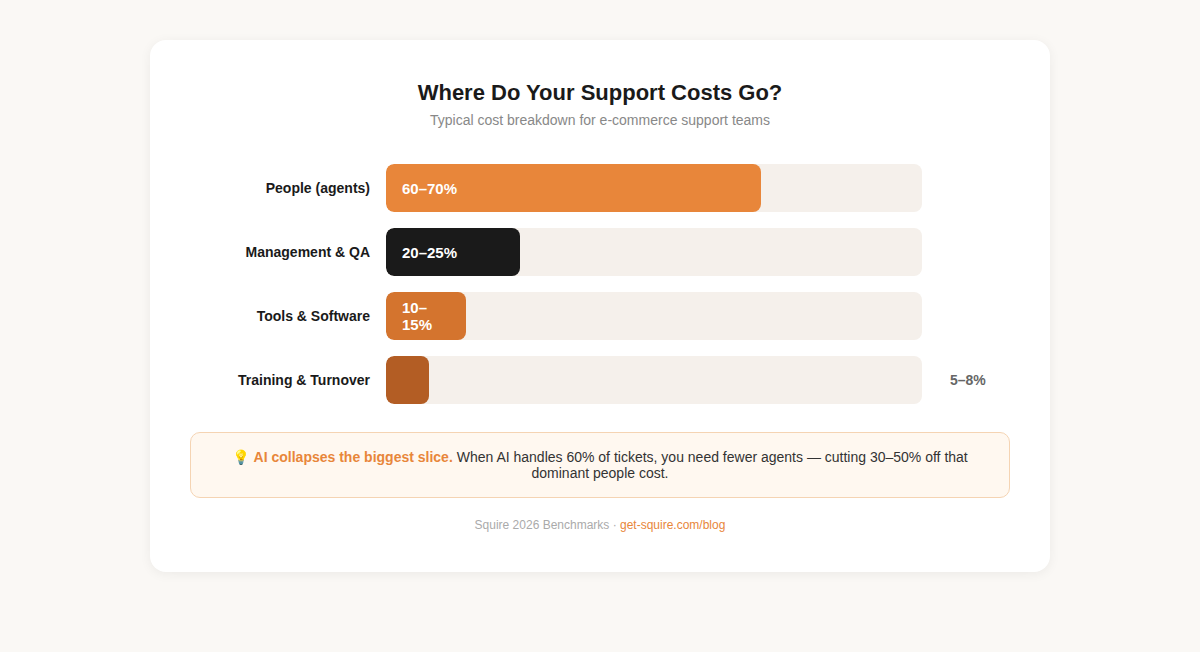
Labor eats the majority of every support budget. According to a 2025 MatrixFlows benchmark study, agent wages and benefits account for 60-70% of total support spend across industries. For e-commerce specifically, the customer support cost breaks down like this:
In-house agents (US): $38,000-$52,000/year fully loaded. That's salary plus benefits, payroll taxes, equipment, and the manager who supervises them. In cities like Austin or Nashville where a lot of DTC brands operate, you're closer to $48K.
Offshore agents: $14,000-$24,000/year. Cheaper on paper. But we've seen stores cycle through 3 offshore teams in a year before finding one that actually understood their products. Each switch costs 4-6 weeks of training time.
The turnover tax. Contact center turnover runs between 30-45% annually. That's not a typo. The QATC (Quality Assurance & Training Connection) has tracked this for years, and e-commerce skews toward the higher end because the work is repetitive and the pay is average. Every agent who quits costs you roughly $4,000-$7,000 in recruiting and training before the replacement hits full productivity.
One more thing nobody counts: management overhead. Someone has to review tickets, coach agents, handle escalations. Even in a 3-person support team, that eats 15-20 hours per week of senior time.
Tools and Software: The Bill That Keeps Growing
Your helpdesk subscription is just the starting point. Here's what the full stack typically looks like for a Shopify store's customer support budget:
- Helpdesk platform: $60-$360/month (Gorgias), $29-$132/seat/month (Intercom), $19-$115/agent/month (Zendesk)
- AI add-ons: $0.90-$1.00 per AI resolution on Gorgias, $0.99 per resolution on Intercom. These are on top of your base plan.
- Returns management app: $30-$200/month (Loop, ReturnGO)
- FAQ/Knowledge base: $0-$50/month
- CSAT survey tool: $0-$100/month
- Phone/voice add-on: $25-$50/agent/month extra on most platforms
Stack all that up and a typical Shopify store with 2-3 agents pays $250-$700/month in software alone. A 5-person team easily crosses $1,000/month when you add AI automation fees.
And here's the part that stings: those per-resolution AI fees compound fast. If your Gorgias AI agent handles 500 conversations a month at $0.90 each, that's $450/month just for the AI. On top of the $360/month Pro plan. On top of whatever you pay for SMS and voice add-ons.
The Hidden Costs Nobody Tracks
This is where the real damage happens.
Training time. New agents need 2-4 weeks before they're fully productive. During that window, they handle maybe 60% of normal volume at 80% quality. For a store processing 100+ tickets/day, that's real money bleeding out.
Quality assurance. Someone needs to spot-check tickets. At minimum, a team lead reviews 5-10% of tickets weekly. That's 3-5 hours per week that doesn't show up on any invoice.
Escalation overhead. Complex tickets get bumped to senior staff. A 2025 LiveChatAI analysis found that management and quality oversight accounts for 20-25% of total support costs across industries. For small teams, it's often higher because the founder handles escalations personally.
Customer churn from bad support. This is the big one. And it's almost impossible to pin a dollar figure on. But here's what we do know: a 2024 Salesforce survey found that 88% of customers say the experience a company provides matters as much as its products. If your first-response time is 24+ hours, you're losing customers. Period. You just can't see exactly which ones.
Cost Benchmarks by Store Size
These benchmarks come from our conversations with Shopify merchants, public industry data from Opensend, Tymely, and MatrixFlows, and our own observations working with stores across the revenue spectrum. (For more on industry-wide metrics, see our guide to reducing WISMO tickets.)
Solo Founder / Small Store (Under 500 Orders/Month)
The setup: You answer support emails between shipping orders and running Facebook ads. Maybe you've got Shopify Inbox or a free Tidio plan. You tell yourself it's free.
The real customer support cost: 8-12 hours per week of your time. If you value founder time at $75-$100/hour (and you should, because that's time not spent on growth), that's $2,400-$4,800/month in opportunity cost.
Cost per ticket: $12-$25. By far the most expensive support per ticket of any store size.
This is the most expensive support configuration in e-commerce. It just doesn't feel that way because no check gets written. One merchant we talked to calculated she spent 47 minutes per support ticket on average because she'd context-switch from product development, lose focus, then take 20 minutes to get back into her real work. Brutal.
Growing Store (500-2,000 Orders/Month)
The setup: 1-2 part-time or full-time agents, plus a paid helpdesk like Gorgias or Zendesk. Maybe some basic automation rules.
The real cost: $3,000-$6,500/month. Break that down: agents ($2,000-$4,000), tools ($200-$500), founder time on escalations ($800-$2,000).
Cost per ticket: $5-$9.
This is the pain point zone. You're big enough that founder-as-support doesn't work, but not big enough for real economies of scale. Every new hire is a big percentage increase in costs, and seasonal spikes (BFCM, holiday returns in January) force ugly choices between understaffing and overspending.
Established Store (2,000-10,000 Orders/Month)
The setup: 3-6 full-time agents, team lead, dedicated helpdesk with automation, returns app, quality monitoring.
The real cost: $10,000-$25,000/month. Agents ($6,000-$15,000), tools ($500-$1,500), management overhead ($2,000-$5,000), training and turnover ($1,500-$3,500 amortized monthly).
Cost per ticket: $3.50-$6.50.
You're starting to see scale benefits. But you're also dealing with actual HR problems: scheduling, sick days, holiday coverage, performance management. Your Slack probably has a #support-escalations channel where the founder still gets pinged 4 times a day.
High-Volume Store (10,000+ Orders/Month)
The setup: 10-25+ agents (in-house, outsourced, or hybrid), enterprise tools, QA team, workforce management.
The real cost: $30,000-$75,000+/month. And that's before any AI costs.
Cost per ticket: $2.50-$5.00. Economies of scale kick in, but so does organizational complexity. You now have meetings about support metrics, dashboards nobody reads, and a vendor relationship manager at your helpdesk provider.
How to Calculate Your Cost-Per-Ticket
Here's the formula. It's embarrassingly simple, but almost nobody does it.
Total Monthly Support Cost ÷ Total Tickets Resolved = Cost Per Ticket
The trick is what goes into "Total Monthly Support Cost." Include all of this:
- Agent salaries and benefits (full loaded cost, not just base salary)
- Helpdesk and tool subscriptions (every app in your support stack)
- AI resolution fees (Gorgias, Intercom, or whatever you're using)
- Manager/team lead time allocated to support (percentage of their salary)
- Training costs amortized monthly (divide annual training spend by 12)
- Recruiting costs amortized monthly (if you replace agents regularly)
- Your own time on escalations and oversight (be honest about this one)
What "Good" Looks Like
For e-commerce, here's how to read your cost per ticket number:
- Under $3/ticket: Either you're incredibly efficient, or you're cutting corners on quality. Check your CSAT scores.
- $3-$6/ticket: Solid. This is where most well-run Shopify stores land.
- $6-$10/ticket: Room for optimization. Usually means too much founder involvement or high agent turnover.
- Over $10/ticket: Something's broken. Could be overstaffing, bad tooling, or (most likely) a solo founder doing support between everything else.
But here's what matters more than the raw number: what's your CSAT relative to your cost-per-ticket? A $4/ticket store with 92% CSAT is crushing it. A $4/ticket store with 71% CSAT is just cheap.
How AI Changes the Math
This is where the spreadsheet gets interesting. And where a lot of the old rules about support staffing stop applying.
The Before-and-After Calculation
Let's take a real scenario. A Shopify store handling 1,200 tickets per month at $5.50 per ticket.
Before AI:
- 1,200 tickets × $5.50 = $6,600/month
- 3 full-time agents + Gorgias Pro ($360/month) + returns app ($100/month)
After AI handles 65% of tickets autonomously:
- 420 human tickets × $5.50 = $2,310
- 780 AI tickets × $0.50 = $390 (using Squire's Growth plan overage rate)
- Squire subscription: $149/month (Growth plan, 400 conversations included)
- Remaining tools: $100/month (returns app)
- Total: ~$2,949/month
That's a 55% reduction in customer support cost. And the 420 human tickets that remain are the genuinely complex ones, which means your agents are doing more interesting work. Turnover drops. Quality goes up on the tickets that actually need a human touch.
Where AI Saves the Most
Not all tickets are created equal. AI crushes the repetitive, data-lookup stuff:
WISMO (where is my order): 18-30% of all e-commerce tickets. AI resolves these at near-perfect rates because it's just pulling tracking data from Shopify. We covered this in depth in our guide to reducing WISMO tickets.
Returns and exchanges: 15-20% of tickets. AI can check return eligibility against your policy, initiate the return, and send the label. No human needed for the straightforward cases. (More on this in our returns automation guide.)
Order status and modifications: 10-15%. "Can I change my shipping address?" "Can I add an item?" Data lookup plus a simple action.
Policy questions: 5-10%. "What's your return window?" "Do you ship to Canada?" These are knowledge-base lookups that AI handles instantly.
Add those up and 50-70% of your ticket volume is AI-ready today. Not in some theoretical future. Right now.
Where Humans Still Win
Complex complaints where a customer is genuinely upset. PR-sensitive situations. VIP accounts where the relationship matters. Edge cases your policies don't cover.
But here's the shift: your humans now spend 100% of their time on these high-value interactions instead of copy-pasting tracking numbers. We've talked to stores where agent satisfaction went up after AI took over the repetitive work. Fewer people doing more meaningful work. Funny how that works.
Shopify Support Tool Pricing: What You'll Actually Pay
Every helpdesk has a "starting at" price on their website. Nobody pays the "starting at" price. Here's what stores actually spend, and how each tool affects your total customer support cost. (See our full chatbot comparison for a deeper look at the AI capabilities of each.)
Look at that "5-Agent Team Total" column. With Gorgias, a 5-person team handling 1,000 tickets/month where AI resolves 500 of them pays roughly $810-$1,350/month (Pro plan + AI fees). With Intercom, the same setup runs $890-$1,650/month.
With Squire, you pay one price. $349/month on Pro covers 1,000 conversations, all channels, unlimited seats. No per-resolution fees stacking on top. No surprise line items. Your January bill looks the same as your December bill (well, unless you blow past 1,000 conversations during BFCM, but even then it's $0.40 per extra conversation, not $0.99).
We built a detailed Gorgias comparison and a Tidio vs Squire breakdown if you want the full details.
5 Ways to Cut Support Costs Without Cutting Corners
1. Let AI Handle the Repetitive 60%
This is the single biggest lever for reducing your customer support cost. If 60% of your tickets are WISMO, returns, and order status lookups, and AI can resolve those at $0.40-$0.60 per conversation instead of $3-$6 per human ticket, the math does itself.
But pick the right AI. A chatbot that deflects customers to a FAQ page isn't the same as an AI agent that actually pulls order data, checks the carrier, and resolves the ticket. One reduces tickets. The other replaces the need for a human on that ticket entirely. Big difference. (Our AI chatbot comparison covers which tools actually do this.)
2. Build a Knowledge Base People Actually Use
A surprising number of Shopify stores have no FAQ page. Or worse, they have one from 2022 that still references a shipping carrier they stopped using. A good knowledge base deflects 15-25% of tickets before they're ever created.
Include: shipping timelines by region, return/exchange instructions with step-by-step screenshots, sizing guides, product care instructions, and your top 10 most-asked questions.
3. Kill WISMO Tickets at the Source
Proactive shipping notifications can cut WISMO volume by 40-50%. Send an email when the order ships, another when it's out for delivery, and a third on delivery confirmation. If a package is delayed, send a proactive update before the customer asks. We wrote an entire guide on this.
4. Make Returns Self-Service
A good returns portal (Loop, ReturnGO, or the returns automation built into tools like Squire) lets customers initiate returns without contacting support at all. Stores that implement self-service returns see 30-50% fewer return-related tickets. More on automating returns here.
5. Audit Your Tool Stack Every 6 Months
You're probably paying for overlapping tools. A helpdesk with built-in chat AND a separate live chat widget. A returns app AND manual return handling in your helpdesk. A CSAT tool AND the built-in satisfaction surveys in your helpdesk.
Consolidation isn't sexy but it saves real money. One merchant we talked to cut $340/month by dropping three apps that overlapped with features already included in her helpdesk.
The Bottom Line
Your support probably costs more than you think. It definitely costs more than your helpdesk invoice suggests.
For most Shopify stores, the real customer support cost is 2-3x whatever they'd estimate off the top of their head. Once you count agent time, tools, training, turnover, management overhead, and your own involvement, the total is genuinely surprising.
AI doesn't make those costs disappear. What it does is collapse the cost structure for 50-70% of your volume. The tickets that are data lookups, policy checks, and status updates become $0.40-$0.60 conversations instead of $4-$6 human interactions. Your team gets smaller, more focused, and better at the work that actually requires judgment.
The old math was linear: more orders → more tickets → more agents → more cost. The new math is different: more orders → more tickets → AI handles the routine ones → your team handles the interesting ones → costs grow at a fraction of the rate.
If you haven't calculated your real cost-per-ticket, do it this week. Use the formula above. Include everything. The number will probably annoy you.
Then ask yourself: what would it look like if AI handled the bottom 60%?
Ready to find out? Start a 14-day free trial with Squire and see the actual numbers for your store. Or if you want to understand the full AI customer support setup process, we've got a 15-minute walkthrough.